Husband's Infidelity: Lawsuit Against the Paramour or Divorce Proceedings in Korea?
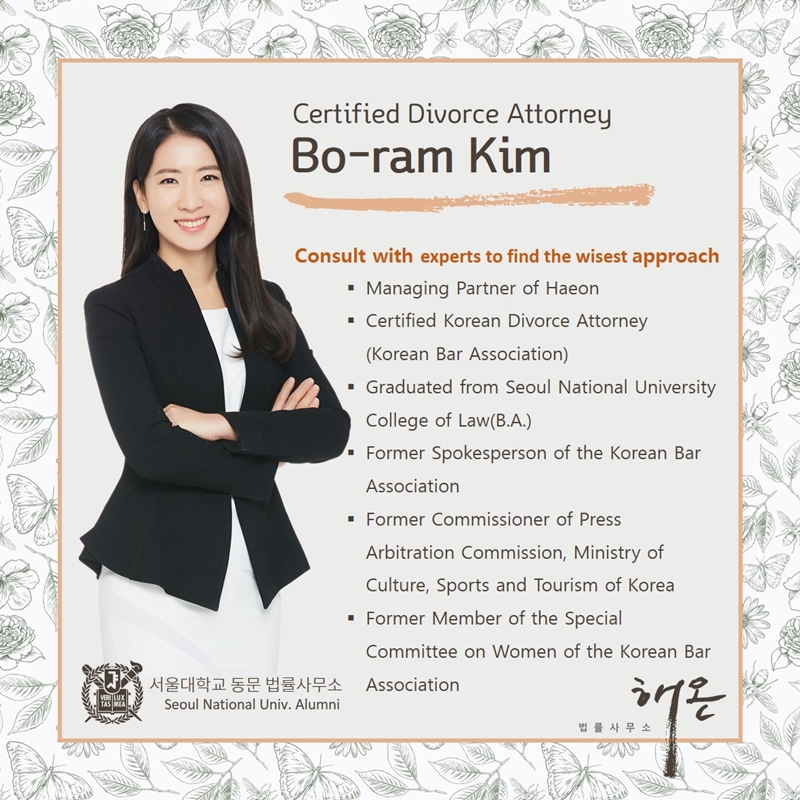
Bo-ram Kim Managing Partner
Request a consultation
The moment you discover your spouse's infidelity, your decision should not be driven by immediate anger but by careful consideration for your future. Law Office Haeon, which has specialized exclusively in divorce and infidelity lawsuits since its establishment, is here to help you determine the most appropriate legal action for your situation in Korea.
1. Pros and Cons of Divorce and Infidelity Lawsuits
Simply put, a lawsuit against the paramour (also known as a "mistress lawsuit" or 상간녀소송) is a legal action that isolates the claim for emotional distress damages (위자료) from the broader scope of divorce proceedings.
Specifically, these damages are claimed not from the unfaithful husband, but exclusively from the third-party paramour who engaged in the affair with him.
This means you do not need to initiate legal action against your husband, file for divorce, or enter into disputes concerning related matters such as child support (양육비) or the division of marital property (재산분할). Of course, it is also possible to claim damages from the paramour concurrently while proceeding with a divorce lawsuit in Korea.
So, what are the respective advantages and disadvantages when choosing between a divorce and a lawsuit solely against the paramour?
⑴ Opting for a Divorce Lawsuit (이혼소송)
① Advantages
• It provides an opportunity to legally terminate the marital relationship completely and begin a new life.
• A divorce lawsuit can resolve all legal matters between the spouses at once, including the dissolution of the marriage, emotional distress damages, division of property, and child custody (양육권). This is a crucial factor to consider if you believe your husband's infidelity is likely to recur throughout your life.
② Disadvantages
• Divorce is a grave and final decision that dissolves a family, and it is difficult to reverse once finalized.
• The process of a family dissolving can be traumatic for children.
• If disputes over property division or child custody become contentious, the litigation period can extend beyond a year, and attorney's fees are typically higher compared to a lawsuit solely against the paramour.
• Beyond damages, you must simultaneously address multiple complex legal issues such as property division and child custody, making the process legally more intricate and requiring extensive preparation.
⑵ Opting Solely for a Lawsuit Against the Paramour (상간녀소송)
① Advantages
• Preservation of Marital Relationship: If you do not wish to divorce or need to maintain the family unit for reasons such as children, you can hold only the third party legally accountable while keeping the marriage intact.
• Effective Termination of the Affair: Being sued often creates significant psychological pressure, leading most paramours to end the adulterous relationship. It is a highly effective means of severing the affair.
Furthermore, in an attempt to minimize their own culpability, paramours often blame the unfaithful husband, which frequently leads to the breakdown of their relationship.
• Relatively Swift and Simple Procedure: Compared to a divorce lawsuit, the legal issue is limited to the single claim of damages, allowing the case to be typically concluded within a relatively short period of 4 to 8 months.
• You can initiate the lawsuit against the paramour first and observe your spouse's subsequent attitude, buying you time to make a final decision about divorce.
• Confirmation of the Husband's Fault: The judgment in a lawsuit against the paramour serves as an official court-issued confirmation of your husband's marital fault. In Korea, an at-fault spouse (유책배우자) is generally barred from successfully filing for divorce if the other party does not consent.
※ While some court precedents have permitted divorce initiated by the at-fault spouse, these are exceptionally rare and involve very specific circumstances.
② Disadvantages
• Upon learning of the lawsuit, the unfaithful spouse may brazenly take the side of the paramour.
• If you do not file for divorce, the court may determine that the marital relationship has not completely broken down, potentially leading to a lower award for damages than in cases where a divorce occurs. However, recent Korean court precedents show a trend toward awarding higher damages in these infidelity cases.

2. Securing Evidence of the Husband's Infidelity
Without objective evidence, both divorce and infidelity lawsuits face a high probability of dismissal (기각). This is because the burden of proof (입증 책임) rests with the plaintiff (원고) who files the suit.
Regardless of which legal path you choose, the evidence of infidelity will be used in the same manner, so the primary focus should initially be on securing proof.
① Key Evidence in Divorce and Infidelity Lawsuits in Korea
1. KakaoTalk conversations, text messages, emails, SNS direct messages, etc., containing affectionate expressions or plans to meet.
2. Photographs or videos showing the two individuals behaving like a couple; conversations or videos recorded on a vehicle's black box.
3. Credit card statements showing joint expenses (e.g., hotels, restaurants, gift purchases).
4. An affidavit (사실확인서) or testimony from an acquaintance who directly witnessed the relationship.
5. Vehicle navigation records showing visits to lodging establishments or the paramour's residence. Evidence such as hotel or apartment elevator CCTV footage can be legally obtained through a court's preservation of evidence order (증거보전 신청) after the lawsuit has been initiated.
② Precautions for Collecting Evidence
You must be cautious of illegal acts while securing evidence. Actions such as trespassing (주거침입) into a residence without consent, installing a listening device in a vehicle, or installing spy apps on a smartphone can result in criminal punishment for violating the Protection of Communications Secrets Act (통신비밀보호법).
Although illegally obtained evidence may occasionally be admitted in civil proceedings in Korea depending on the gravity of the matter, this is exceptional. It is not worth risking criminal liability.
Can Illegally Collected Evidence Be Admitted in Korean Courts?

3. Is It More Advantageous to File a Divorce and Infidelity Lawsuit Simultaneously or to File the Infidelity Lawsuit First?
This is a frequent question from clients who consult with Law Office Haeon regarding spousal infidelity. If your situation aligns with the circumstances below, it is generally advisable to proceed with the lawsuit against the paramour first.
① If you are contemplating divorce but are not yet certain
Once a final judgment is secured in the lawsuit against the paramour, your husband is legally established as the at-fault spouse (유책배우자). In Korea, it is extremely difficult for an at-fault spouse to obtain a divorce against the wishes of the innocent party. This means the decision to divorce rests entirely with you, the victim.
② If you want to prevent the husband and the paramour from forming a joint defense
When a divorce lawsuit and an infidelity lawsuit are filed simultaneously, both the husband and the paramour become defendants (피고). Since evidence detrimental to the paramour is also detrimental to the husband, they are likely to actively communicate and conspire to conceal or destroy evidence.
However, if you file only against the paramour first, a husband who does not want a divorce may be more cooperative with your lawsuit. In practice, this often leads to securing more substantial evidence.
4. Law Office Haeon
Where lawyers entrust their own divorce cases.
Where opposing counsel refers their family members for adultery cases.
Where recommended by adversaries who have lost cases against it.
This is the story of Law Office Haeon.
However, Haeon does not rest on the recognition of these professionals and continues to strive forward. Our expertise is reaffirmed by the trust placed in its experience and results by professionals from various fields—including famous K-POP entertainers, national athletes, and broadcast journalists—who have chosen Haeon.
Schedule a Consultation with Law Office Haeon