The Step-by-Step Procedure of a Lawsuit Against an Affair Partner in Korea
Bo-ram Kim Managing Partner
Request a consultation
Once you have retained an attorney specializing in adultery cases and submitted the collected evidence, the litigation process will officially commence.
A civil lawsuit proceeds according to a prescribed procedure, and it is crucial to understand the necessary actions and corresponding strategies for each stage.
The duration of the lawsuit varies depending on the complexity of the case, the clarity of the evidence, and the court's schedule.
However, a lawsuit against an affair partner typically takes approximately four months to one year to conclude in Korea.
1. Step 1: Drafting and Filing the Complaint with the Court
All lawsuits in Korea begin when the plaintiff files a 'Complaint' (소장) with the court. The complaint is the most critical document that signals the start of the litigation, serving to legally organize the plaintiff's claims and convey them to the judiciary.
Pursuant to Article 249 of the Korean Civil Procedure Act, a complaint must include the following essential information:
① Parties(원고, 피고)
The personal details of the plaintiff (the person initiating the lawsuit) and the defendant (the affair partner being sued), including their names, resident registration numbers, addresses, and contact information.
② Prayer for Relief (청구취지)
This section clearly states the desired outcome of the lawsuit. For instance, it may specify the exact amount of damages for emotional distress and damages for delay sought by the plaintiff, such as: "The defendant shall pay to the plaintiff OOO KRW, along with interest calculated at the rate of 12% per annum from the day following the service date of a copy of this complaint until the date of full payment."
③ Cause of Action (청구원인)
This provides a detailed account of the factual background and legal arguments supporting the prayer for relief. It must logically and chronologically describe when, where, and how the spouse and the affair partner committed the act of infidelity; the circumstances indicating the affair partner was aware of the marital status; and the resulting emotional distress suffered by the plaintiff.
The complaint, along with the collected evidentiary materials (documentary evidence), is submitted to the competent court (either the court in the defendant's jurisdiction or the Family Court where a divorce proceeding is pending).
※ For reference, if a lawsuit against an affair partner is filed independently in Korea, it proceeds in a general civil court. However, if it is filed concurrently with a divorce lawsuit against the spouse, the case is transferred to and handled by the Family Court.
2. Step 2: The Defendant's Submission of an Answer and Response
The complaint filed by the attorney undergoes a review by the court before being served on the defendant. The defendant, upon receiving a copy of the complaint, must submit an 'Answer' (답변서) to the court within 30 days, outlining their position regarding the plaintiff's claims.
In the Answer, the defendant should clearly state whether they admit, deny, or have no knowledge of each fact alleged by the plaintiff in the complaint. If denying a fact, the defendant should provide the reason for the denial and present evidence supporting their own assertions.
The defendant's response typically falls into one of the following categories:
① Denial of the Act of Infidelity
Asserting that the plaintiff's claims are groundless and that the relationship was not improper.
② Ignorance of Marital Status
Admitting to the relationship but claiming to have been completely unaware that the other person was married.
③ Argument of Prior Marital Breakdown
Contending that the plaintiff's marriage had already irretrievably broken down before the act of infidelity occurred.
④ Contesting the Amount of Damages
Acknowledging some facts but arguing that the amount of damages for emotional distress claimed by the plaintiff is excessive.
If the defendant fails to submit an Answer within the 30-day period, the court may consider the defendant to have admitted to all of the plaintiff's allegations (a deemed admission) and may render a judgment in favor of the plaintiff without holding a hearing (a judgment by default), as stipulated in Article 257 of the Korean Civil Procedure Act.
3. Step 3: Pleading Dates and Examination of Evidence
Once the defendant's Answer is submitted, the court schedules 'Pleading Dates' (변론기일) to formally hear the arguments from both sides and examine the evidence. Pleading dates are typically held several times at intervals of one to two months.
During these hearings, the plaintiff and the defendant (or their respective attorneys) appear in court to present their arguments orally, explain the submitted evidence, and rebut the opposing party's claims.
Between pleading dates, both parties engage in a fierce legal battle by submitting additional arguments, rebuttals, and evidence through written documents called 'Preparatory Briefs' (준비서면). In this process, the court may conduct the following examinations of evidence to clarify the facts:
• Examination of Documentary Evidence: Reviewing the contents of submitted documents (e.g., message histories, credit card statements).
• Request for Information: Sending official inquiries to telecommunication companies, financial institutions, or public agencies to request and receive information on specific facts.
Depending on the case, the court may attempt to facilitate an amicable resolution between the parties through mediation. If an agreement is reached during a 'Mediation Date' (조정기일), the lawsuit is concluded without a judgment.
4. Step 4: Rendering of Judgment and Appeal
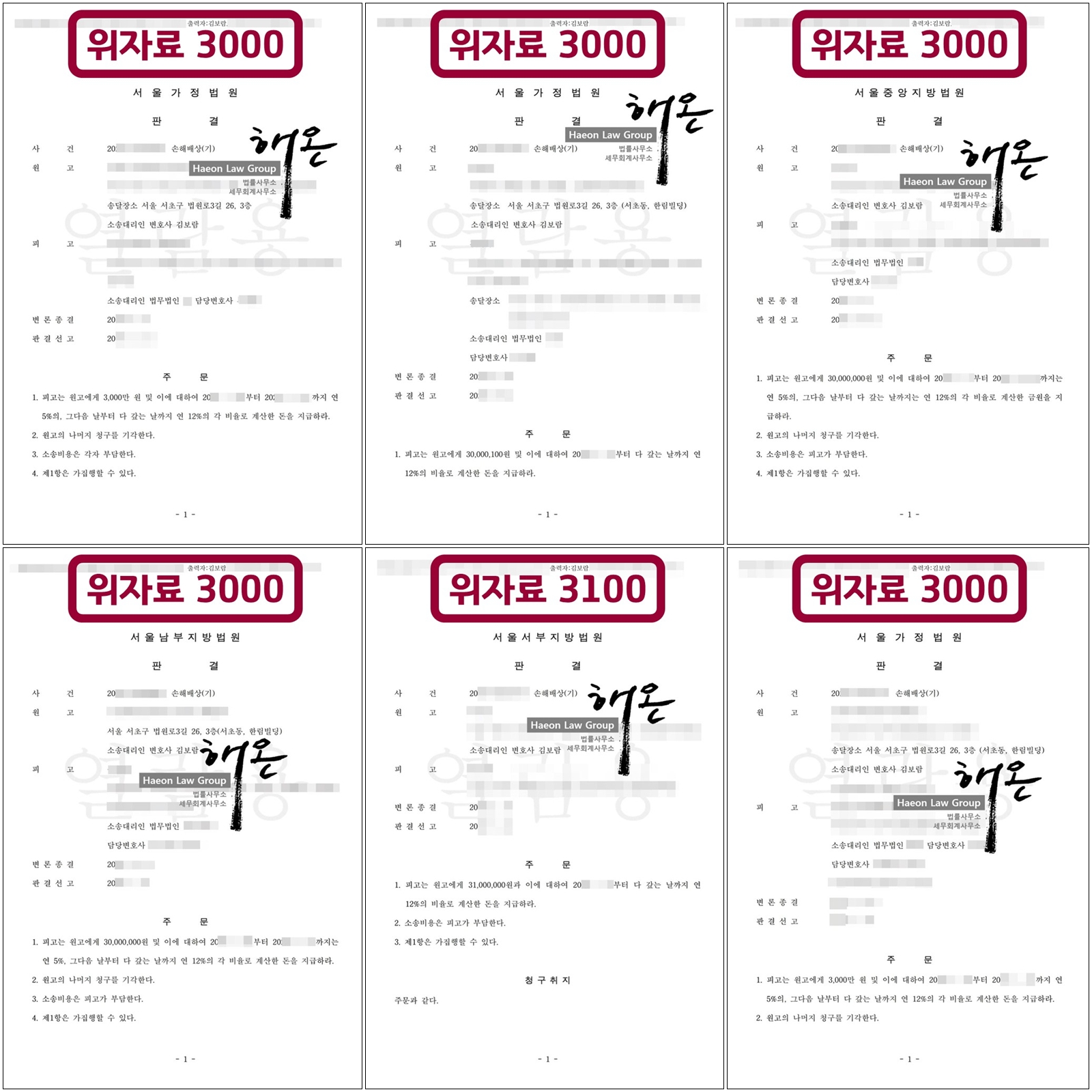
When the court determines that it has sufficiently reviewed the arguments and evidence from both sides and there are no further issues to deliberate, it concludes the pleadings and sets a 'Date for the Rendering of Judgment' (판결 선고기일). On this date, the presiding judge announces the judgment by reading the operative part (the conclusion) and a summary of the reasons for the judgment in court.
① Judgment in Favor of the Plaintiff (원고승 Partial or Full)
A judgment in which the court acknowledges the defendant's liability and orders them to pay a certain amount of damages for emotional distress to the plaintiff.
② Judgment Against the Plaintiff (원고패, 기각 Dismissal of Claim)
A judgment in which the court finds the plaintiff's claims to be without merit and does not grant the requested relief.
A party who disagrees with the judgment may seek a re-evaluation from a higher court (the appellate court) by filing a 'Notice of Appeal' (항소장) with the court of first instance within 14 days from the date they received the written judgment. It is critical to adhere to this deadline, as the judgment becomes final and conclusive if the period elapses.
5. Law Office Haeon
Where lawyers entrust their own divorce cases.
Where opposing counsel refers their family members for adultery cases.
Where recommended by adversaries who have lost cases against it.
This is the story of Law Office Haeon.
However, Haeon does not rest on the recognition of these professionals and continues to strive forward.
Our expertise is reaffirmed by the trust placed in its experience and results by professionals from various fields—including famous K-POP entertainers, national athletes, and broadcast journalists—who have chosen Haeon.
Schedule a Consultation with Law Office Haeon